Home > Blog > How to measure ring size accurately at home before ordering online?
How to measure ring size accurately at home before ordering online?
Instead of taking the risk, you can measure your ring size accurately at home using simple tools and following a few critical timing rules.
Here are the step-by-step methods and insider tips to help you.
When to measure your finger?
Your finger size can change throughout the day, so it's important to measure when your finger is at its largest for the most accurate result.
Time of Day: It's best to measure your finger in the evening. By this time, your fingers will have naturally swelled due to circulation, warmth, and activity. Avoid measuring in the morning when your fingers tend to be smaller.
Temperature: Aim to measure your finger at room temperature. Cold weather causes fingers to shrink, while warm weather or heat (like after a hot shower) can cause them to swell. A comfortable room temperature will give you the most accurate measurement.
Frequency: Measure the same finger two or three times on different days. If the measurements vary, take the largest reading to ensure comfort and accuracy.
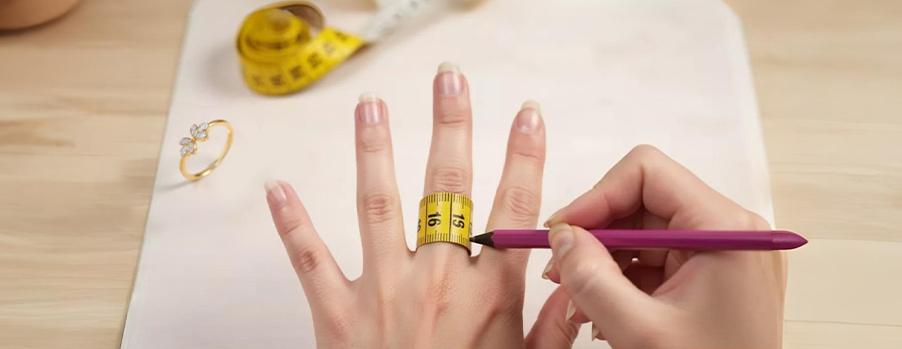
Method 1: The paper strip circumference (if you have no ring)
This method calculates the circumference, or the distance around your finger.
| Items You Will Need | Steps to Take |
| * A paper strip or string | 1. Begin by cutting a narrow strip of paper, ensuring it’s as wide as the ring band you wish to purchase |
| * A pen | 2. Encircle the paper strip comfortably around the finger you intend to measure. It should be fitting, but not too tight. It should enable a slight level of movement. |
| * A ruler | 3. Using the pen, mark where the paper meets to form a complete loop. 4. Unwrap the paper and measure the distance between the two marked points using a ruler in millimetres. This gives you the circumference of your finger. 5. To match the measurement to a ring size, check the size guide on the retailer’s website when you buy a diamond ring online. |
Method 2: Measuring an existing ring (the diameter method)
| Items You Will Need | Steps to Take |
| * A ruler marked in millimetres | 1. Take the ring that fits the intended finger and place it on a flat surface. |
| * A ring that fits the intended finger comfortably | 2. Measure the straight distance across the very centre of the ring’s inner edge (the hole). This is the internal diameter. 3. Make sure the measurement is in millimetres. |
A perfect fit isn’t just about the measurement; it also depends on how the ring moves on your finger.
| Sizing Factor | What It Means | Tip to Remember |
| 1. The knuckle challenge | The ring should slide over your knuckle easily. It should not spin loosely on the base of your finger. | If your knuckle is much larger than the finger’s base, measure both. Choose a size that offers slight resistance when sliding over the knuckle. |
| 2. The bandwidth rule | Rings with a wider band (over 5mm) tend to be tighter than thinner bands. This is because the wider bands cover more skin. | Going up half a size will be wise for added comfort if you’re buying a wide band ring. |
Sizing for a surprise:
If you're considering diamond engagement ring designs as a surprise gift, here are a couple of discreet methods to get the correct size:
Borrow a ring: Borrow a ring your partner wears on the same finger and use the second method to measure its internal diameter.
Use an accomplice: Have a close friend or family member ask your partner directly about their ring size, or take them ‘window shopping’ for rings without revealing your intentions.
Getting your ring size right the first time eliminates delay and cost. By following these accurate at-home methods, you can confidently buy diamond rings online.
Looking for diamond engagement ring designs?Explore our elegant and versatile diamond ring collection. Our jewellery pieces come with authentication certificates and complete customisation freedom. We are committed to making your purchase seamless. Our diamond rings are available in every half-size to ensure you get the perfect fit for your precise measurement. You can shop with confidence knowing every purchase is backed by our 7-day return/exchange policy and a lifetime exchange and buyback policy.